
Smart indoor climate system for business centers
Purpose of the solution
This reference solution is designed to create a controlled, stable and energy-efficient indoor climate in the office spaces and coworking areas of a business center. In such buildings the load on ventilation and cooling changes constantly because of varying room occupancy, irregular tenant schedules and intensive use of meeting rooms. Instead of running ventilation and cooling “at maximum” all the time, the system adapts them automatically in real time to the actual air quality (CO₂, temperature, humidity). This prevents over-ventilation and excessive cooling and reduces the energy consumption of the chiller and the supply and exhaust systems, which are the main electricity consumers in the building. At the same time, it keeps the environment comfortable for employees and visitors: even temperature, no overheating or drafts, a stable CO₂ level. This directly affects concentration, productivity and how tenants perceive the space. As a result, the building becomes energy-efficient, predictable to operate and more attractive to long-term tenants.
Solution components
-
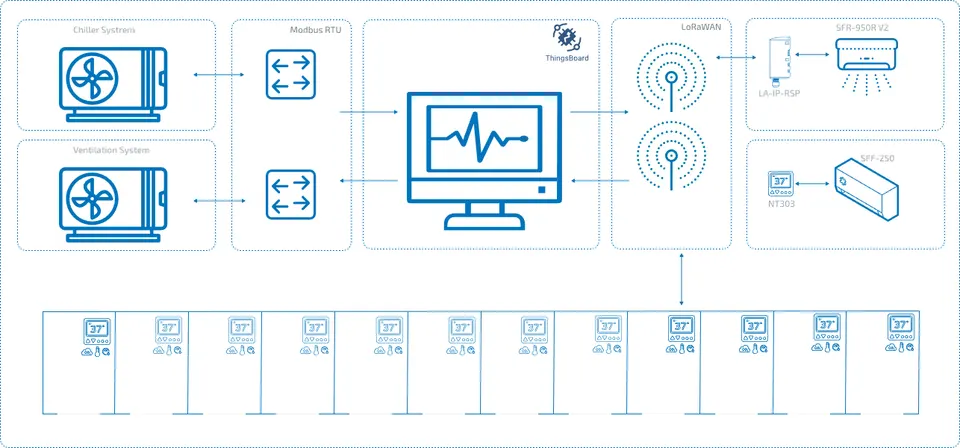
NM103 indoor climate sensors (temperature, humidity, CO₂)
-
Shuft SFF-250 fan coil units (wall-mounted) → the standard controller is replaced with an NT303 for adaptive CO₂-based control
-
Shuft SFR-950R V2 cassette fan coil units (ceiling-mounted) → control over RS-485 via OrionMeter LA-IP-RSP (Modbus RTU)
-
Air handling units (AHUs) with CO₂-based airflow control (Modbus control)
-
Integration of the AHUs and the Trane chiller over Modbus
-
Monitoring, control and analytics platform: ThingsBoard Edge
AHU control principle
| CO₂ level | AHU mode | Result |
|---|---|---|
| ≤ 600 ppm | Minimum airflow | Energy savings |
| 600–900 ppm | Nominal airflow | Comfortable indoor climate |
| > 900 ppm | Increased airflow and ventilation rate | Fast recovery of air quality |
Economic effect
- Actual chiller load: 250–450 kW
- Savings from adaptive control: 10–22%
Result
- CO₂ ≤ 900 ppm in all zones
- Stable thermal comfort, with no overheating or drafts
- Lower operating costs
- The space becomes more comfortable and attractive to tenants
- Building systems operate transparently, controllably and predictably
Key point
The AHUs and the fan coil units work in coordination, not independently:
- The AHUs control air quality
- The fan coil units control temperature
They do not conflict. The system does not “blow cold air” unless rising CO₂ requires cooling.