
Where LoRaWAN device makers go wrong and what BatteryCare technology changes
1–2 years vs. 10–15 years
The paradox of battery-powered LoRaWAN
LoRaWAN was originally designed as a technology for devices with ultra-low power consumption.
Official specifications and marketing materials from radio chip manufacturers stress that 10–15 years of battery life is a normal, expected service life for a single node running on a lithium battery.
Under ideal conditions this is indeed the case:
-
long sleep periods (sleep mode),
-
infrequent transmissions,
-
energy-efficient modulation,
-
no active reception,
-
minimal leakage.
From an engineering standpoint, LoRaWAN is fully capable of running for decades.
But the market reality is different
Many commercial LoRaWAN devices:
-
fail after 12–24 months,
-
require regular battery replacement,
-
run unstably in winter,
-
cause massive join storms,
-
degrade network quality,
-
drive up operating costs.
Users, municipalities and enterprises that deploy networks of hundreds or thousands of devices find that the equipment does not actually live up to what the standard promises.
So where is the cause hidden?
The paradox is that the problem is not LoRaWAN as a technology. Nor is it the batteries.
The problem is how most manufacturers design the power supply of their devices. A battery life of 10–15 years is only possible if the following concept is observed:
-
low currents → battery,
-
pulse loads → buffer,
-
high efficiency → DC/DC,
-
stable voltage → no resets.
Yet the vast majority of devices on the market are built on a different logic:
-
the radio is powered directly from the battery,
-
an LDO regulator with heat losses is used,
-
there is no energy buffer,
-
passivation is treated as a “fault”,
-
the battery operates in a mode it was not designed for.
As a result, devices that should last a decade barely make it to their second year.
Mistakes of LoRaWAN device makers
Powering the radio directly from the battery
Most LoRaWAN devices power the radio module directly from a Li-SOCl₂ battery, even though its chemistry is designed for low currents of 1–3 mA. A LoRaWAN transmission at 14 dBm requires peaks of up to 50–58 mA, which is 15–20 times the battery’s rated current. As a result:
- the voltage sags instantly
- the MCU goes into brownout
- the device resets
- battery life gets shorter
- the risk of join storms grows
This architecture is guaranteed to cut the service life of the device to 1–2 years.
Using an LDO without an energy buffer
Manufacturers often use linear regulators (LDOs) because they are simple and cheap. But an LDO has two critical drawbacks:
- Low efficiency as the voltage drops
The difference of 3.6 → 3.0 V is lost as heat. Losses reach 30–40%, which speeds up battery discharge.
- No buffer for peak loads
All radio pulses pass through the battery. This causes:
- growing passivation,
- lower available power,
- inability to maintain a stable uplink,
- degradation of the battery chemistry.
The device runs “on the edge” practically from day one.
Misunderstanding passivation and battery operating conditions
Li-SOCl₂ batteries have a protective passivation layer that ensures ultra-low self-discharge. This is a feature, not a bug. But manufacturers:
- try to “break through” the passivation
- use depassivation as a workaround
- design circuits that draw high currents from the battery
- do not provide an EDLC buffer
- ignore the rise of ESR in winter
As a result, the battery operates outside its optimal zone, in a mode it was not designed for. This leads to:
- rapid degradation,
- failures in winter,
- resets,
- join storms,
- premature death of the device.
The main mistake of the market is trying to power a modern LoRaWAN radio module directly from a Li-SOCl₂ cell without a buffer and without a DC/DC converter. This architecture is technically incompatible with the requirements of LoRaWAN.
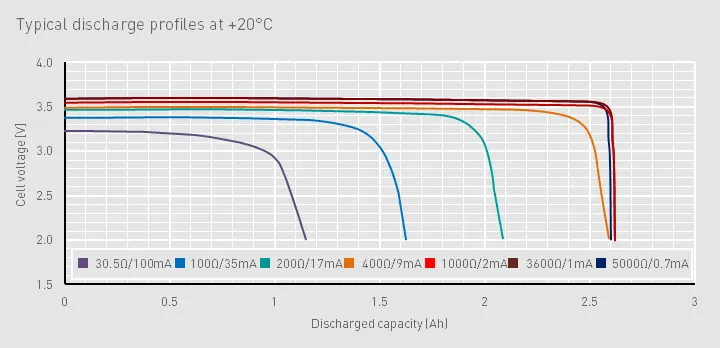
Why competitors’ devices last only 1–2 years
Brownout, resets and the inability to send a packet
In competitors’ devices the radio is powered directly from the battery. When a LoRaWAN transmission starts:
- the SX1276/SX1262 needs 50–58 mA,
- the battery can deliver only 1–3 mA,
- the voltage sags sharply,
- the MCU goes into brownout,
- the device resets.
After the reset it tries to send the data again, and again it loses power. This cycle can repeat dozens or hundreds of times a day. This leads to:
- incorrect operation,
- uncontrolled battery drain,
- rapid wear of the cell,
- further deterioration of the radio link.
In effect, the device starts “killing” itself.
Join storms and pollution of the LoRaWAN network
Every reset leads to another attempt to join the network (Join Request). But the device browns out again before it receives the Join Accept. The result is a join storm: an uncontrolled stream of requests on the air. This causes:
- channel congestion,
- reception collisions,
- lower network quality for all devices nearby,
- more lost messages,
- shorter range and lower stability.
A join storm is one of the most destructive scenarios for a LoRaWAN infrastructure. And devices with an improper power supply trigger it automatically, with no user involvement.
ESR rise in winter and accelerated battery degradation
As the temperature drops, the internal resistance of Li-SOCl₂ rises:
- x5 at −20 °C
- x10 at −40 °C
This means:
- the battery almost stops delivering current,
- radio transmission (TX) becomes impossible,
- sometimes even LoRaWAN reception is impossible,
- the device falls completely into brownout cycles.
Each such cycle:
- drains the battery further,
- strengthens the passivation,
- increases ESR even more,
- accelerates chemical degradation.
In the end, a capacity of 2400–2700 mAh turns into 200–400 mAh of usable capacity, so the device survives 1–2 years, and sometimes less.
Competitors’ devices fail not because “LoRaWAN consumes a lot” or “the batteries are bad”. They die because the battery operates in a mode it is physically not designed for, and the radio module does not get a stable power supply. Result: brownout → join storm → battery degradation → failure after 12–24 months.
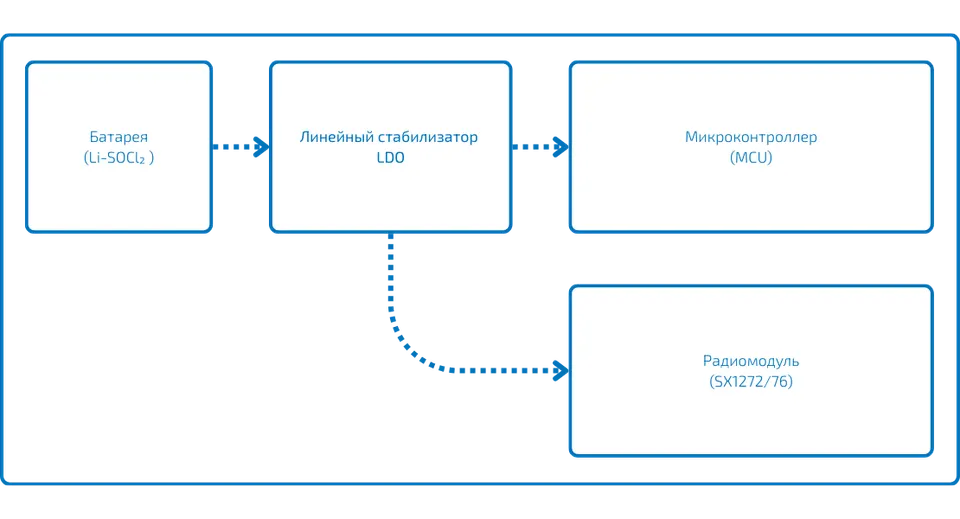
Architecture of typical LoRaWAN devices on the market: battery (Li-SOCl₂) → linear regulator (LDO) → microcontroller (MCU) and radio module (SX1272/76)
Why a replaceable battery is a false solution
Replacing the battery costs more than the device itself
In real conditions, a battery replacement involves:
- a technician’s trip,
- access to the site,
- opening the enclosure,
- installing a new battery,
- closing the enclosure,
- checking communication and recommissioning.
Such an operation often costs 40–100% of the price of the entire device. For projects with hundreds or thousands of sensors, this turns into huge operating costs.
Replacing the battery does not remove the cause of fast discharge
“The battery drains quickly → let’s make it replaceable.”
But the problem is not the battery. The problem is that:
- the radio is powered directly from Li-SOCl₂,
- there is no energy buffer (EDLC),
- an LDO regulator with heat losses is used,
- the battery operates with peak currents dozens of times above normal.
In other words, the battery in such devices works from the start under conditions incompatible with its chemistry. Replacing it simply restarts the same destructive cycle.
Replaceable batteries accelerate network degradation
After a battery replacement, the device:
- joins the network again,
- may run unstably until it is calibrated,
- sometimes falls into repeated brownout resets,
- generates extra join packets.
In large networks this can lead to:
- local channel congestion,
- lower network quality,
- lost messages from other nodes.
So a replaceable battery is also a source of network instability.
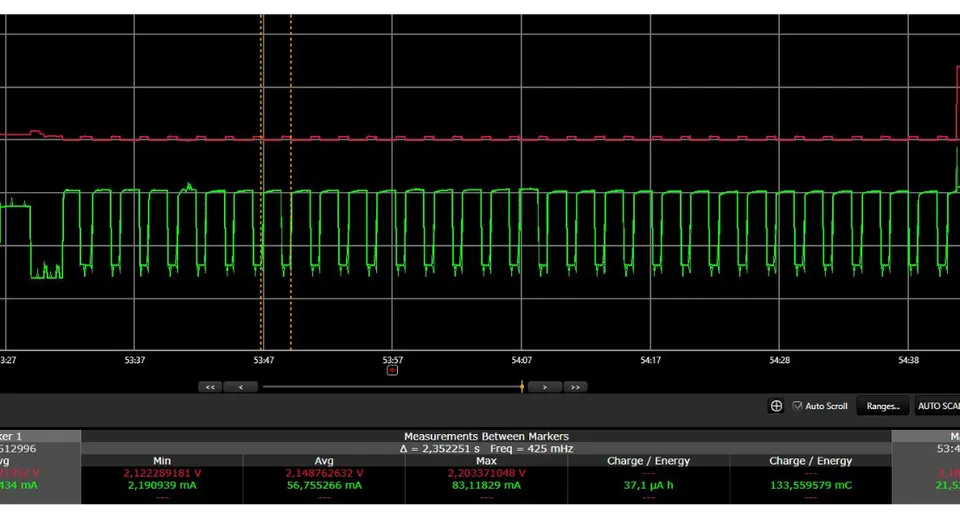
Cyclic resets every 2.35 s when the transmitter turns on: the supply voltage drops to 2.2 V and triggers BOR. The cause is the linear regulator: the voltage drop across it pulls the MCU voltage down to the BOR threshold during transmission.
A replaceable battery undermines the very idea of IoT
LoRaWAN was conceived as a technology:
- with no maintenance,
- with no site visits,
- with no battery replacements,
- with 10–15 years of battery life.
If a device requires regular maintenance, it is effectively not an IoT device but a terminal that needs an annual service cycle.
Cheap for the manufacturer, expensive for the customer
For the manufacturer, a replaceable battery is:
- easy,
- cheap,
- fast.
But for the customer it means:
- annual costs,
- operational complexity,
- battery logistics,
- staff trips to the sites,
- risk of human error,
- no predictability.
This is a classic case where savings in production turn into major costs over the life cycle of the system.
A replaceable battery does not solve the core problem, which is the wrong power architecture. As long as current peaks pass through the battery, the device will fail within 1-2 years, whether the cell can be replaced or not.
BatteryCare technology
BatteryCare technology is an engineered power architecture designed to eliminate the root causes of early degradation of LoRaWAN devices. It is based on separating the functions of the battery and of the pulse power source, on a high-efficiency DC/DC converter and on power management at the microcontroller level.
Separating low and pulse currents
In OrionM2M devices the battery never delivers high currents. Its only task is to provide a steady low current of 1–3 mA, which matches the natural operating mode of Li-SOCl₂ chemistry. The power architecture looks like this:
- Battery → operates in a stable low-current mode
- EDLC (supercapacitor) → supplies all peaks from 40 to 150 mA
- The radio module is powered without voltage sags, even at sub-zero temperatures
This completely eliminates voltage sags, resets and premature battery degradation.
High-efficiency DC/DC converter with current control
BatteryCare uses a switching regulator of the TPS6274x family, which:
- has an efficiency of up to 94%,
- reduces heat losses to almost zero compared with an LDO,
- limits the EDLC charging current to a safe level,
- provides a stable voltage of 1.8–3.3 V depending on the operating mode.
The key difference:
- the battery does NOT power the radio during TX
- the battery only charges the EDLC with a low current
- the EDLC takes the entire peak
This removes the very cause of brownout cycles.
Managed power supply and passivation protection
The microcontroller controls the supply level via VSEL:
- 1.8 V: deep sleep
- 2.3–2.5 V: measurements, sensors
- 3.0–3.3 V: LoRaWAN transmission
What this gives:
- minimal average consumption,
- no heat losses,
- predictable behavior at −40 °C,
- the battery always operates in its optimal zone,
- passivation becomes an advantage rather than a problem.
As a result, the devices:
- run stably for years,
- need no depassivation,
- create no join storms,
- do not degrade prematurely.
BatteryCare is the only architecture that fully isolates the battery from pulse loads. This is exactly what makes a real 10–15 years of battery life possible for LoRaWAN devices.
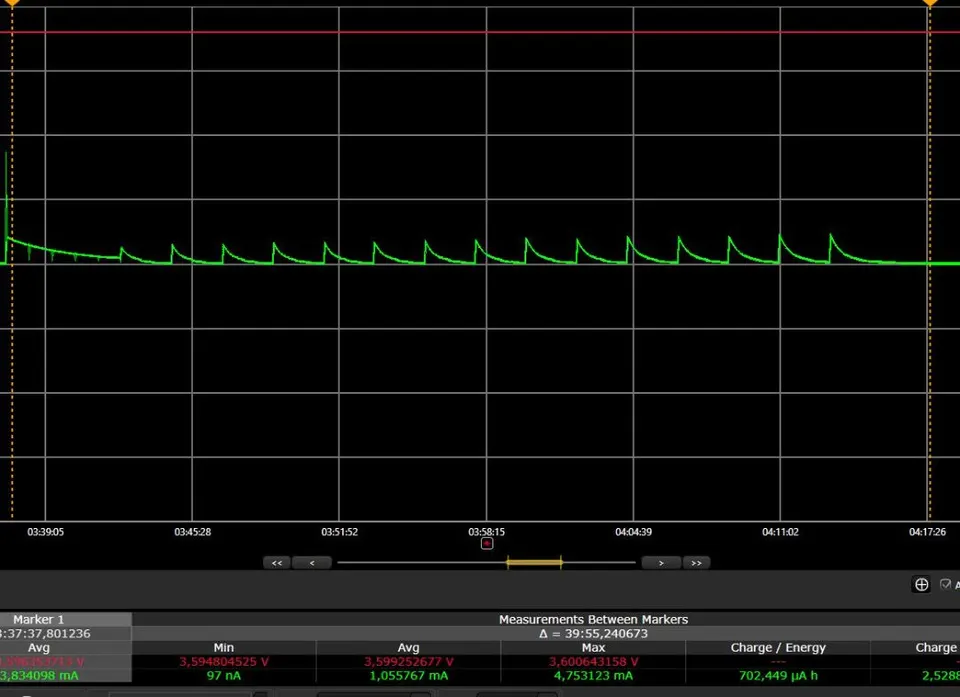
One-time charge of the buffer capacitor at first power-up. Peak current 4.75 mA
Why “EDLC in parallel with the battery” is a mistake
When the market began to realize that Li-SOCl₂ batteries tolerate the pulse currents of the radio module poorly, the logical step was to add a supercapacitor (EDLC). Some manufacturers did go the EDLC route, but made a critical mistake: they simply connected it in parallel with the battery. As a result, such a circuit:
- fundamentally solves nothing,
- and in some cases makes things even worse.
The battery still has to charge the EDLC with a peak current
If the supercapacitor sits directly on the battery, then:
- when the device powers up or after a transmission, it is discharged,
- it tries to charge up to the battery voltage as fast as possible,
- the charging current is limited only by the internal resistance of the battery and the wiring.
For Li-SOCl₂ this means:
- the battery again has to deliver tens of milliamperes,
- the same pulse mode we wanted to get away from comes back,
- voltage sags occur,
- the MCU goes into brownout,
- the device resets.
In other words:
It is as if we added an EDLC, but the peak current still flows through the battery, only now not during TX but while the supercapacitor is charging.
From the battery’s point of view, nothing got easier.
Brownout has not gone away: it has only shifted in time
In a correct architecture, the EDLC should:
- charge slowly, with a limited current,
- and discharge quickly, delivering the peak to the radio.
In the “EDLC in parallel with the battery” circuit, the opposite happens:
- EDLC charging → fast
- current → high
- the battery “sags” precisely at the moment of charging
The result:
- the device may lose power not during the transmission,
- but right after it or at the next wake-up,
- which makes its behavior even less predictable.
In fact, brownout is not eliminated; it is simply moved to a different point of the operating scenario.
A supercapacitor adds parasitic losses and leakage
An EDLC is not an ideal energy store. It has:
- leakage current,
- self-discharge,
- temperature dependence.
If it hangs directly on the battery, then:
- the battery constantly recharges the EDLC,
- even when the radio is silent,
- additional constant losses appear.
In other words:
Instead of saving the battery, we have added a constant hidden discharge path.
Cell voltage goes outside the operating range
With a direct parallel connection: the voltage across the EDLC and the battery is the same, charging and discharging cause sharp jumps, the radio module and the MCU may see nonlinear transients.
If there is no DC/DC and no current limiter:
- the voltage may swing while the EDLC charges,
- this leads to logic glitches,
- unstable radio operation,
- partly “random” failures.
For Li-SOCl₂ this scenario is even more destructive
Li-SOCl₂ has:
- high energy,
- low self-discharge,
- but a strictly limited current range.
When an EDLC is hung in parallel without current limiting:
- the battery is constantly “jerked” by charging pulses,
- the passivation behaves unstably,
- ESR grows,
- the capacity drops even faster.
In other words:
By trying to “improve” the power supply with an EDLC connected in parallel, such devices actually hasten the death of the battery.
The join storm does not go away
Our main goal is to get rid of join storms and resets. When the EDLC works incorrectly:
- the device still periodically loses power,
- it still cannot complete the join procedure,
- it still floods the network with endless Join Requests.
So, as far as the LoRaWAN network is concerned:
- a device with an EDLC in parallel with the battery behaves almost as badly as one without an EDLC,
- for the network operator and the customer there is no difference: the network is polluted and the device is unstable.
How it should really be done
The correct architecture:
- battery → through a current-limited DC/DC → charges the EDLC with low currents,
- EDLC → a local buffer that supplies all TX/RX pulses,
- the radio and the MCU are powered from a regulated voltage, not directly from the battery.
In this case:
- the battery never sees peaks of 40–150 mA,
- the EDLC does not discharge it directly,
- there are no sharp voltage drops,
- no brownout,
- no join storms,
- the battery lasts 10–15 years, as intended.
Simply adding an EDLC is not enough. If the supercapacitor is connected in parallel with the battery without current limiting and without a DC/DC, it does not solve the problem but only moves it elsewhere and accelerates the degradation of Li-SOCl₂.
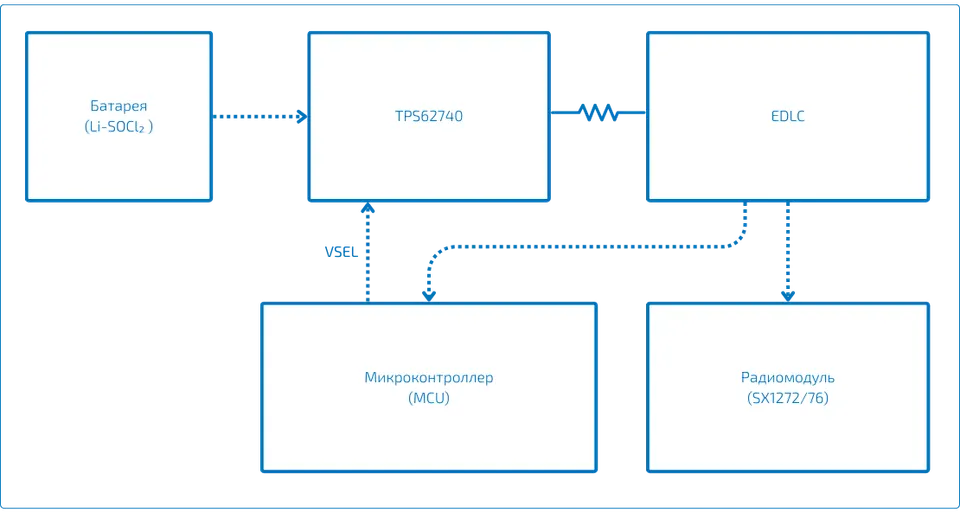
BatteryCare power architecture: battery (Li-SOCl₂) → TPS62740 → resistor → EDLC → microcontroller (MCU) and radio module (SX1272/76); the MCU controls the TPS62740 over the VSEL line
OrionM2M power architecture with BatteryCare technology
A real 10–15 years of battery life
BatteryCare technology lets OrionM2M LoRaWAN devices run for decades not thanks to “improved batteries” but thanks to a properly designed power architecture in which every component plays its optimal role. Real longevity comes from a combination of three factors:
- the battery is not exposed to pulse loads,
- the radio runs on a stable power supply,
- energy losses are kept to a minimum.
No voltage sags, no resets
The device does not go into brownout because:
- peak currents always come from the EDLC,
- the battery sees only smooth low currents,
- the DC/DC maintains a stable voltage,
- the MCU and the radio are powered within a controlled range of 1.8–3.3 V.
What this gives:
- a stable uplink,
- predictable operation at all temperatures,
- no join storms,
- no cyclic restarts.
If a device does not reset, it does not waste its battery.
Minimal consumption through power management
Average power consumption is the key to real battery life. BatteryCare provides:
- a 1.8 V supply in deep sleep (lower MCU consumption)
- a reduced voltage for the sensors (optimization without loss of accuracy)
- 3.0–3.3 V only at the moment of transmission (when it is really needed)
- DC/DC efficiency of up to 94% (minimal heat losses: energy goes into useful work, not into heating the enclosure)
These effects add up to a multifold increase in service life.
The battery operates in its optimal mode 100% of the time
Most importantly: the Li-SOCl₂ battery behaves as if it were powering a microcontroller without a radio module: with an even, low, stable current of 1-3 mA. The battery does not:
- deliver 50–150 mA,
- discharge in pulse modes,
- let the voltage sag,
- break down its passivation layer,
- accelerate ESR growth.
Under these conditions, the batteries:
- work the same way as in metering devices,
- retain their capacity for decades,
- lose less than 1% per year,
- need no maintenance.
In other words, the service life built in by the battery manufacturer (10-15 years) is finally realized in full.
BatteryCare is not an “optimization” but the elimination of the fundamental conflict between Li-SOCl₂ batteries and the LoRaWAN radio.
Once the battery stops seeing pulse currents, the devices run stably for 10-15 years with no maintenance, even at −40 °C.
An additional effect: zero operating costs
Longevity is not only about energy but also about economics:
- no battery replacements,
- no site visits,
- no dismantling,
- no recommissioning,
- no network failures,
- no degradation of the LoRaWAN infrastructure.
The total TCO of such devices is 3-7 times lower than that of competitors’ devices.
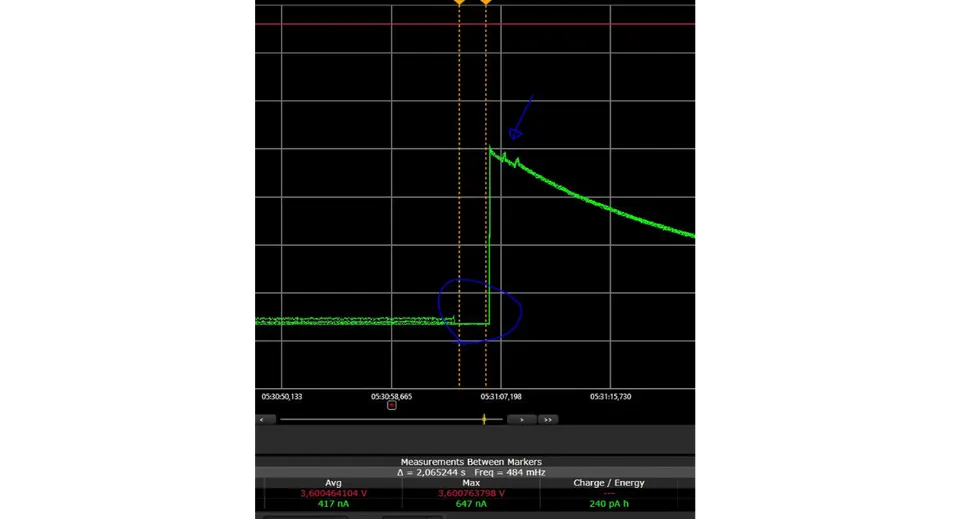
Zoomed-in view of a transmission. Maximum battery current: 0.647 µA. The blue circle marks the transmission itself; the arrow marks the opening of the RX windows.
Conclusion
The fact that many LoRaWAN devices last only 1–2 years has nothing to do with battery quality, the specifics of the standard or operating errors. The root of the problem is the wrong power architecture, in which the Li-SOCl₂ battery is forced to operate in pulse modes it is physically not designed for. This is what causes voltage sags, resets, join storms, rapid ESR growth and premature degradation. BatteryCare technology eliminates this conflict at the circuit design level. The battery operates only in the low-current zone, the EDLC takes all the pulses, and a high-efficiency DC/DC converter provides a stable supply to the radio module and the microcontroller. This approach eliminates brownout, prevents join storms, preserves the battery chemistry and ensures predictable device operation even at −40 °C.
The result is a LoRaWAN device that truly delivers on the promises of the standard: 10–15 years of battery life with no maintenance, no battery replacements, no failures and no hidden operating costs. BatteryCare is not an improvement of the classic circuit but a new power architecture that restores the true purpose of LoRaWAN: to create reliable, stable and truly self-sufficient battery-powered devices.